



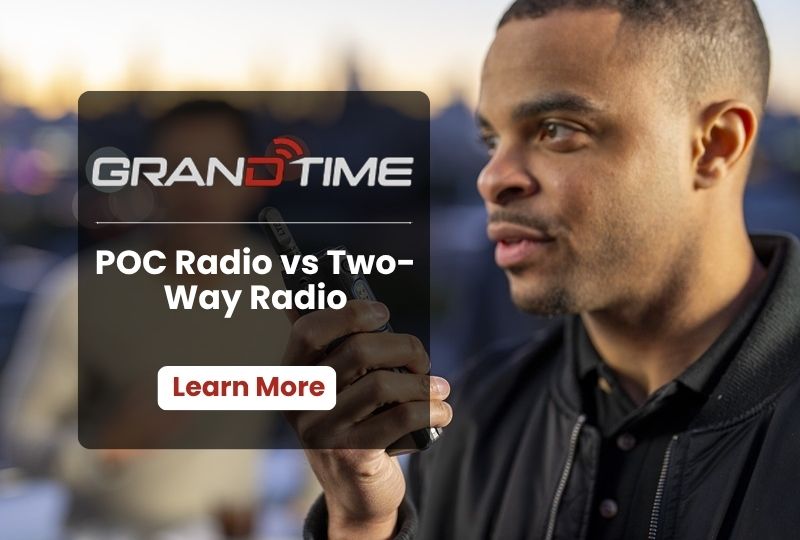
If your team relies on instant, push-button communication, you have probably run into two main options: traditional two-way radios and POC radios. Both let you talk to your crew with a single button press, but they work on completely different technology, and that difference affects range, cost, and reliability.
This guide breaks down what separates a POC radio from a two-way radio, so you can figure out which one actually fits your operation.
What Is a Two-Way Radio?
A two-way radio, sometimes called a walkie-talkie or land mobile radio (LMR), sends voice over dedicated radio frequencies. No cell tower or internet connection is involved. You press the talk button, and your voice travels directly through the air to every radio tuned to the same channel.
This direct radio-frequency link is why two-way radios are so common in warehouses, construction sites, and event security. They work instantly, even in basements, tunnels, or rural areas where cell signal is weak or missing entirely. Most commercial two-way radios also require an FCC license, since they operate on regulated frequency bands.
What Is a POC Radio?
POC stands for Push-to-Talk over Cellular. Instead of using radio frequencies, a POC radio sends your voice as data over 4G, 5G, or Wi-Fi networks, the same way a phone call or app-based message travels. You still press one button to talk, but the signal routes through the cellular network rather than the open air.
Because POC radios ride on existing mobile infrastructure, they do not need dedicated towers, repeaters, or FCC licensing. As long as there is cell coverage, a POC radio can reach a teammate across the city, the state, or even a different country.
Key Differences Between POC Radios and Two-Way Radios
1. How They Transmit
Two-way radios use licensed or unlicensed RF frequencies for a direct, radio-to-radio connection. POC radios convert voice into data and send it through a cellular or Wi-Fi network, similar to a VoIP call.
2. Coverage and Range
This is usually the deciding factor. A standard two-way radio covers roughly 2 to 6 miles, depending on terrain, buildings, and power output. Adding repeaters can extend that range, but it takes extra hardware and cost.
A POC radio has no fixed range limit. Coverage depends entirely on the cellular network, so two users can talk across an entire country as easily as across a parking lot. The tradeoff is that POC radios stop working the moment there is no signal, while two-way radios keep working in dead zones since they do not depend on outside infrastructure.
3. Licensing and Setup
Commercial two-way radios operating on business frequencies typically require an FCC license in the US. POC radios skip that requirement entirely, since they run on public cellular networks that carriers already manage.
4. Cost Structure
Two-way radios usually mean a higher one-time hardware cost, plus optional repeater infrastructure if you need wider coverage. After that, there are no recurring fees.
POC radios tend to cost less upfront but require an ongoing SIM card data plan and, in many cases, a platform subscription for dispatch or fleet management features.
5. Latency
Two-way radios connect almost instantly since the signal travels directly between devices. POC radios add a small delay, usually less than a second, because the voice data has to route through the cellular network. In most day-to-day use this delay is barely noticeable, but it matters in split-second emergency response.
6. Extra Features
Two-way radios are built for one job: voice communication. Some higher-end models add GPS or emergency alert buttons, but the core function stays simple.
POC radios usually include more built-in capabilities, since they run on smart platforms. Common features include real-time GPS tracking, text and multimedia messaging, group and individual calling, lone worker alerts, and integration with dispatch software.
Which One Fits Your Team?
Choose a two-way radio if:
- Your team works within a fixed site, like a warehouse, factory floor, or construction zone
- You operate in areas with weak or no cell coverage
- You want zero recurring costs after the initial purchase
- Instant, zero-latency communication matters for safety
Choose a POC radio if:
- Your workforce is spread across a wide area, a city, a region, or multiple job sites
- You need GPS tracking, messaging, or dispatch features alongside voice
- You want to scale up the number of users quickly without buying new infrastructure
- Reliable cellular coverage is available where your team operates
Many organizations end up using both. Two-way radios handle short-range, on-site coordination, while POC radios connect supervisors, remote teams, or mobile field units across longer distances. Public safety, energy, and logistics operators often combine the two so they are covered whether they are on-site or spread across a region.
Grandtime builds POC radios alongside body cameras and helmet cameras, so field teams can pair reliable push-to-talk communication with video documentation in one connected kit. You can see the current lineup on our POC radio page.
Frequently Asked Questions
Is a POC radio the same as a walkie-talkie?
It works the same way: one button to talk, but a POC radio uses cellular data instead of radio frequencies. This gives it a much larger coverage area than a traditional walkie-talkie.
Do POC radios need an FCC license?
No. Since POC radios use existing cellular networks rather than dedicated radio frequencies, they do not require FCC licensing in the US.
What is the range of a POC radio compared to a two-way radio?
A two-way radio typically covers a few miles depending on terrain and power. A POC radio has no real distance limit, as long as there is cellular or Wi-Fi coverage available.
Can POC radios work without cell service?
No. If there is no cellular or Wi-Fi signal, a POC radio cannot transmit. This is the main reason two-way radios remain popular in remote or underground locations.
Do POC radios have a monthly fee?
Yes, most POC radios need an active SIM data plan, and some also require a subscription for dispatch or fleet management platforms. Two-way radios generally have no ongoing fees after purchase.
Which is better for emergency response?
Two-way radios usually win here because of instant, zero-latency communication that does not depend on network availability. Many teams keep two-way radios as a backup even after switching to POC for daily operations.