





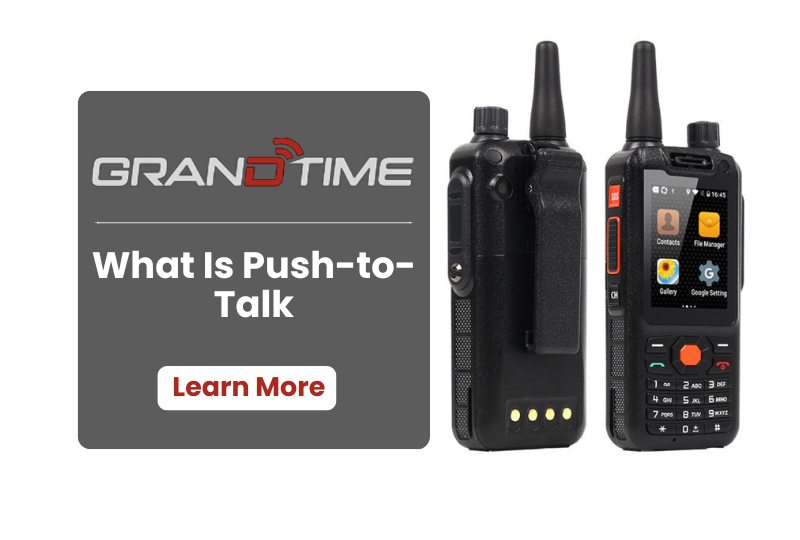
If you have ever watched a security guard, a construction foreman, or a police officer speak into a radio by holding down a single button, you have seen push-to-talk in action. It is one of the oldest communication methods still in daily use, and it remains popular because nothing beats the speed of pressing a button and talking instantly to an entire team.
This guide breaks down what push-to-talk actually is, how the technology works behind the scenes, and where it is used today.
What Is Push-to-Talk (PTT)?
Push-to-talk, often shortened to PTT and sometimes called press-to-transmit, is a way of communicating where you press and hold a button to speak, then release it to listen. Only one person can talk on the channel at a time, while everyone else listens in real time.
This differs from a phone call, where both people can speak and hear each other at the same moment. PTT is a one-direction-at-a-time system, which keeps conversations short, clear, and easy to follow, especially when several people are on the same channel.
The technology has been around for roughly eight decades, starting with early radio transceivers used by military and emergency crews. It has since evolved from bulky analog handsets into rugged digital radios, smartphone apps, and cellular-connected devices.
How Does Push-to-Talk Work?
At its core, PTT relies on a simple mechanical or digital switch that flips a device between two modes: listening mode and transmitting mode.
Here is the basic sequence:
- Press the button. The device switches from receive mode to transmit mode.
- Speak. Your voice is picked up by the microphone and converted into a signal.
- Signal travels. Depending on the device, that signal moves over a radio frequency, a cellular network, or Wi-Fi to reach everyone listening on the same channel or talk group.
- Release the button. The device switches back to receive mode so you can hear replies.
This entire exchange usually happens in under a second, which is why PTT feels almost instant compared to dialing a number and waiting for someone to pick up.
Half-Duplex vs Full-Duplex Communication
PTT operates on what is known as a half-duplex system. Data can travel in both directions, but only one direction at a time. This is why you cannot talk and listen simultaneously on a PTT device, and why users often say “over” to signal they are done speaking.
A regular phone call, by contrast, uses full-duplex communication, where both parties can talk and hear each other at the same time. Half-duplex may sound like a limitation, but in group settings it actually prevents overlapping voices and confusion, since only one person can transmit at once.
What are the Types of Push-to-Talk Technology
PTT is not tied to a single type of device. Over the years, it has branched into a few distinct categories.
Traditional Two-Way Radios (LMR)
Land Mobile Radios, commonly known as walkie-talkies, transmit voice over dedicated radio frequencies. They do not need internet or cellular coverage, which makes them reliable in remote areas, but their range is limited to a few miles unless repeaters or towers extend the signal. Setting up a wide-coverage LMR network also usually requires FCC licensing and infrastructure costs.
PTT Apps on Smartphones
Many businesses now use PTT apps that turn a regular smartphone or tablet into a walkie-talkie. These apps route voice data over the internet, so coverage depends entirely on cellular or Wi-Fi signal strength rather than radio frequency range.
Push-to-Talk Over Cellular (PoC) Radios
PoC radios combine the familiar feel of a handheld radio with the reach of 3G, 4G LTE, and Wi-Fi networks. Instead of relying on line-of-sight radio waves, a PoC radio sends your voice as data to a server, which then relays it to every device on your talk group almost instantly, no matter how far apart your team members are.
Because PoC radios ride on existing cellular infrastructure, they skip the cost of repeaters, towers, and radio licensing altogether. This is a major reason industries like law enforcement, construction, and logistics have been shifting toward PoC devices for teams that operate across wide areas or multiple job sites.
Key Features of Modern PTT Devices
Beyond the basic press-and-talk function, most modern PTT devices, especially PoC radios, now include:
- Group and individual calling, so users can talk to one person or an entire channel
- GPS location tracking, useful for dispatch and safety monitoring
- Encrypted transmissions, which protect sensitive conversations from interception
- Long battery life and rugged builds, designed for outdoor and industrial conditions
- Integration with dispatch software, allowing supervisors to coordinate multiple teams from one console
Where Push-to-Talk Is Used
PTT has stayed relevant because it solves a specific problem: getting a message to a group of people instantly, without dialing, texting, or waiting for a callback. That makes it a natural fit for:
- Public safety and law enforcement, where officers need hands-free, split-second communication
- Construction sites, where crews are spread across large areas and cannot always answer a phone
- Energy and utilities, for coordinating field teams working in remote or hazardous locations
- Transportation and logistics, for dispatchers managing drivers across regions
- Security and event management, where teams need to relay information quickly during incidents
In each of these environments, the ability to reach a whole team with one button press matters more than having a private, one-on-one conversation.
Push-to-Talk vs Regular Phone Calls
It helps to compare PTT directly against a standard phone call to see why so many industries still prefer it.
A phone call connects two people privately and requires dialing, ringing, and often voicemail if the other person is unavailable. PTT skips all of that. You press one button, and your voice reaches everyone on the channel at once, which is critical in situations where seconds matter, such as an accident on a job site or a security incident.
That said, PTT is not meant to replace phone calls entirely. It works best for short, operational updates rather than long or detailed conversations.
Choosing the Right PTT Device for Your Team
The right choice usually depends on how spread out your team is and what kind of coverage you need. Teams working within a single site or building often do fine with traditional two-way radios. Teams spread across cities, states, or job sites generally get more value from a PoC radio, since it relies on cellular coverage rather than radio range.
Grandtime designs rugged 4G POC radios built for exactly this kind of distributed teamwork, with GPS tracking and instant group calling for industries like public safety, construction, and energy. If your team needs nationwide reach without the cost of building a private radio network, it is worth exploring POC radio options built for field conditions.
Frequently Asked Questions
What does PTT mean on a radio?
PTT stands for push-to-talk, referring to the button you press and hold to transmit your voice before releasing it to listen.
Is push-to-talk the same as a walkie-talkie?
Walkie-talkies are one type of PTT device. The term push-to-talk also covers smartphone apps and PoC radios that use cellular networks instead of radio frequencies.
Does push-to-talk require an internet connection?
Traditional two-way radios do not need internet since they use radio frequencies directly. PTT apps and PoC radios do need internet or cellular data to send voice as a signal.
Why can’t both people talk at the same time on PTT?
PTT uses half-duplex communication, meaning the channel can only carry a signal in one direction at a time. This keeps group conversations organized and prevents overlapping voices.
Is push-to-talk over cellular (PoC) better than traditional radios?
It depends on the use case. PoC radios offer wider coverage and extra features like GPS tracking without the cost of radio infrastructure, while traditional radios can work better in areas with no cell signal.
Summary
Push-to-talk has survived decades of communication technology changes because it does one thing extremely well: it gets a message to a group instantly. Whether that message travels over radio waves or a cellular network, the core idea stays the same: press the button, talk, and let go. As more teams spread across wider areas, PoC radios are becoming the modern answer to a technology that has never really gone out of style.