





Walk into any tech store or scroll through any gadget review site, and you will see the terms “smart glasses” and “AR glasses” used as if they mean the same thing. They don’t. The two categories share some hardware and even some marketing language, but they are built for different jobs, and they perform very differently once you put them on.
This guide breaks down exactly what separates smart glasses from AR glasses, how each one works, and which type actually makes sense depending on what you plan to use them for.
What Are Smart Glasses?
Smart glasses are eyewear built around sensors, connectivity, and audio rather than a visual display. Think of them as a wearable computer accessory that sits on your face instead of your wrist. Most smart glasses include a camera, microphones, speakers, and a wireless connection to your phone.
Their main job is to let you interact with digital assistants, take photos or video, listen to music, and get spoken information without pulling out your phone. Some newer models add a very small display element, like a status light or a simple notification, but that is not their core function.
Popular consumer smart glasses focus on convenience. You can ask a voice assistant a question, get real-time translation through your earpieces, or record a point-of-view video while keeping your hands free. The intelligence lives mostly in the audio and sensor layer, not in what you see through the lens.
What Are AR Glasses?
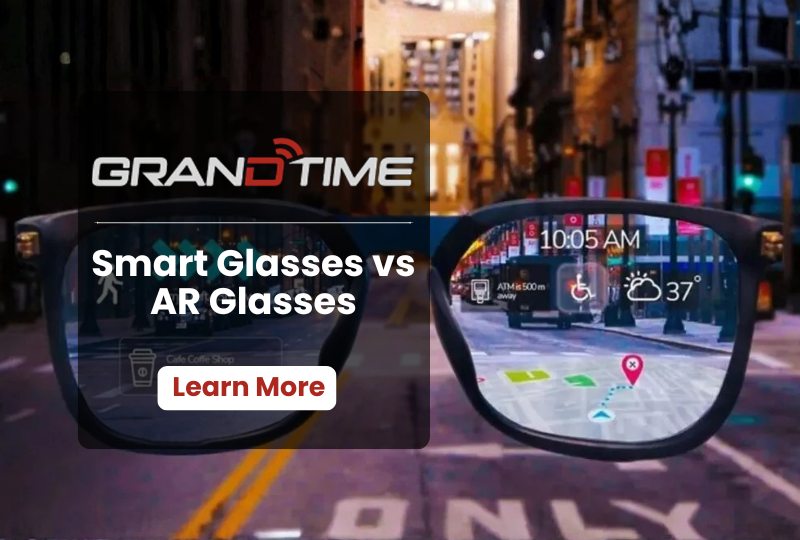
AR glasses are built around a visual display system using AR (Augmented Reality). Their defining feature is the ability to project digital images, text, or graphics directly into your line of sight while you still see the real world around you.
This is done through optical technology such as waveguides, birdbath optics, or micro projectors that beam light onto a treated lens. The result is a transparent overlay: virtual content appears to float in front of you, layered on top of physical objects, without blocking your view of what is actually there.
This is the core distinction. A true pair of AR glasses must be able to render meaningful visual content in your field of vision, not just a blinking light or a tiny icon. If a technician looks at a machine and sees repair instructions appear next to the actual part, that is augmented reality in action.
The Core Difference in One Sentence
Smart glasses focus on hearing and sensing your environment. AR glasses focus on visually overlaying digital content onto your environment. That single distinction shapes almost everything else about how the two devices are designed and used.
Key Technical Differences
Display technology:
Smart glasses typically skip a full display entirely or use a minimal one for basic alerts. AR glasses rely on waveguide optics, LCoS projectors, or micro OLED panels to render usable visual overlays in real time.
Field of view:
Field of view, often shortened to FOV, measures how much virtual content you can see at once. Entry-level AR glasses usually sit in the 25 to 30 degree range, while enterprise and industrial models often reach 40 to 60 degrees for better task accuracy. Smart glasses generally do not have this specification since they are not display-first devices.
Primary use:
Smart glasses are built for voice commands, hands-free capture, and quick information access. AR glasses are built for tasks that need step-by-step visual guidance, spatial awareness, or real-time overlays such as equipment schematics or navigation cues.
Hardware complexity:
AR glasses generally pack more sensors, including cameras for spatial tracking, gyroscopes, and sometimes depth sensors, to keep digital content anchored correctly in physical space. This added complexity is also why AR glasses tend to cost more and consume more battery than standard smart glasses.
Form factor:
Smart glasses are usually lighter and closer in look to regular eyewear. AR glasses, especially industrial-grade ones, are often bulkier due to the optical engine and battery needed to power a bright, sunlight-readable display.
Where do they overlap?
The confusion around these terms exists for a real reason. Many modern devices blend both categories. Some AI-powered smart glasses now include a small display for notifications or navigation arrows, technically giving them light AR capability. At the same time, some AR glasses include AI assistants for voice commands and object recognition, borrowing from the smart glasses playbook.
Because of this overlap, the safest way to tell them apart is to ask one question. Does the device project meaningful visual content into your line of sight? If yes, you are looking at AR glasses. If the value is mostly in audio, sensing, and voice interaction, you are looking at smart glasses.
Real World Use Cases
Consumer smart glasses are popular for everyday tasks like hands-free photography, music, calls, and quick voice searches. They appeal to people who want a lightweight, all-day wearable without a learning curve.
AR glasses shine in professional and industrial settings. A field technician repairing equipment can see wiring diagrams overlaid directly on the machine in front of them. A warehouse worker can see picking instructions without looking down at a handheld scanner. A remote expert can see exactly what an on-site worker sees and guide them step by step, cutting down on travel and downtime.
This is also where AR glasses are gaining serious ground in public safety, construction, and energy sectors. Officers and field workers can get live data, navigation, or identification support directly in their field of view, while keeping both hands free for the task at hand. Grandtime’s AI AR glasses are built around exactly this kind of frontline use, combining AR overlays with AI-powered recognition for teams working in demanding, hands-free environments. If you want to see how these devices are applied across industrial and public safety roles, our AR/AI glasses lineup breaks down the available options.
Which One Should I Choose?
If your goal is casual daily use, staying connected, taking hands-free photos, or getting voice assistance on the go, smart glasses are usually the better fit. They are lighter, more affordable, and simpler to use right out of the box.
If your work involves tasks that benefit from visual guidance, remote expert support, or hands-free access to technical data, AR glasses are worth the investment. The higher price and bulkier design are trade-offs for genuine functional value in the field.
Some Frequently Asked Questions
Are AR glasses the same as VR headsets?
No. VR headsets fully block your view of the real world and replace it with a digital environment. AR glasses let you see the real world while adding digital content on top of it.
Can smart glasses become AR glasses with a software update?
Not usually. AR capability depends on physical display hardware like a waveguide or projector. A software update cannot add a visual overlay system that does not already exist in the device.
Do AR glasses work outdoors in bright light?
Many industrial AR glasses are built for outdoor use and use high-brightness displays, often rated above 2,000 nits, so the overlay stays visible even in direct sunlight.
Why do AR glasses cost more than smart glasses?
The optical engine, sensors, and processing power needed to render an accurate visual overlay add high cost compared to a device that primarily handles audio and basic sensing.